

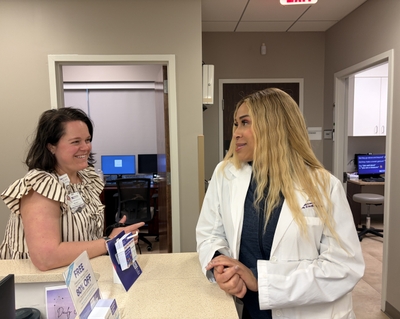
When a patient walks into Dr. Desireé Dawson’s exam room for the first time — often nervous, sometimes bracing for bad news — there’s a good chance they’ll be met with an animated smile, a pat on the leg, maybe even a friendly joke to break the ice.
Dawson, a cardiologist at Novant Health Heart & Vascular Institute - Steele Creek, aims to make cardiology feel human and approachable. That warmth is by design.
“I'm like, ‘Hey, we're friends, right?’” she said, sitting in a clinic room late on a winter afternoon after all her patients had been cared for and the staff was packing up for the day. “I need you to be comfortable with me, because it should be a good conversation. I need to know what’s going on, and we’ll figure out exactly what we’re doing moving forward.”
It’s a style rooted in Dawson’s own journey into medicine — and in her special passion for helping women protect their hearts. In a specialty where women make up only about 15% of practicing cardiologists nationwide and the percentage of clinicians from underrepresented minority groups continues to be low, Dawson knows her presence alone can make a difference for patients who want to be heard.
“When you see a female cardiologist — general, interventional, electrophysiology — it doesn’t matter,” she said. “Women run to us.”
Exceptional cardiovascular care awaits you
The spark that shaped her
Dawson grew up in the town of Mount Pleasant, South Carolina, near Charleston, with two brothers and parents who were both pastors. She spent her childhood fascinated with science, and it was her pediatrician, Dr. John Ward, who sealed the deal.
“He was always smiling, always joking with my parents, answering every question,” Dawson said. “His bedside manner was phenomenal. I thought, ‘I could do that. I could be that kind of doctor.’”
She studied genetics at the University of Georgia, then spent a few years in the workforce before returning to Charleston for medical school at Medical University of South Carolina — becoming the first doctor in her family.
During rotations, cardiology surprised her. “We learned about EKGs, drugs, physiology — I was like, ‘OK, this is kind of cool. How do women get into this profession?’ Because I knew it was male-oriented,” she said. “But I realized I could really get into cardiology and be an advocate for women.”
A decade of internal medicine training and cardiology fellowship followed. She built her early career in Baton Rouge, Louisiana, before moving to Charlotte.
Why it’s important to know these numbers
Getting screened for these key health numbers can help identify potential risks for chronic conditions like diabetes, heart disease and stroke and start you on a path to better health:
early career in Baton Rouge, Louisiana, before moving to Charlotte.
Why women need to take their symptoms seriously
Dawson sees a pattern with many women: They ignore symptoms or rationalize them away.
“We tend not to take care of ourselves when we have a family and all the things going on,” she said. “And we tend to brush off a lot of symptoms — and sometimes real symptoms.”
She has diagnosed patients with multi‑vessel disease — severe blockages — who had been brushing off symptoms for months.
“I tell them, ‘I'm so glad you came in,’” she said.
Her advice to all her patients, and especially women: Know your numbers. (See the box above.) Get checked regularly. Listen to your body. And if someone brushes off your concerns but you’re still worried, listen to your gut.
“If your primary care doctor doesn't think it’s anything, but you think it is — book your own cardiology appointment,” she said. “We’re past the point where referrals are required to see a specialist.”
A physician who practices what she preaches
Dawson’s passion for prevention comes from experience — her patients’ and her own.
She wakes up at 4 a.m. on workout days and heads to the gym to lift weights or do cardio. She meal preps, limits sugar and eats mostly whole foods. She models the advice she gives her patients and especially tries to drive home the message that exercise matters more than people think.
“When you're active, you notice symptoms earlier,” she said. “If you suddenly get short of breath or feel chest pain, you know something’s not right. But if you're inactive, things can sneak up on you. You're missing opportunities.”
Treating high blood pressure is a special passion. She loves the challenge of uncovering potential causes of heart disease — genetics, diet, weight — and loves seeing the transformation when patients make changes.
“They come in saying, ‘Dr. Dawson, I did what you told me to do!’ And I’m like, ‘Good for you!’ It gets me excited.”
Dawson says what keeps her energized — joyful, even — is her faith.
In addition to being a cardiologist, she’s also the pastor at a church in Charleston that she grew up in and that both of her parents led. She travels back frequently on weekends to preach and handle church affairs.
Her days start with 30 minutes of prayer on FaceTime with her mother. Her Bible travels with her. Between patients, she prays quietly or listens to gospel music through her AirPods.
“People ask how I stay joyful doing all this,” she said. “It’s the strength of the Lord.”
‘Don’t shy away from symptoms’
If Dawson could leave patients with one message, it would be this:
“Don’t shy away from symptoms. Cardiology should not be this big fearful experience.”
She wants women, especially, to feel empowered — not intimidated — to make appointments, ask questions and insist on answers.
“If you have symptoms that are new or concerning,” she said, “just make your own appointment.”
She smiled.
“It’ll be fun,” she said. “We’re gonna have a good time.”


