Allison Lawson learned she had high blood pressure when she “failed” her physical in seventh grade.
She was a softball player with a family history, on both sides, of hypertension. Most people with hypertension respond well to medication, but Lawson was allergic to nearly every medicine she tried.
Lawson, 36, has had migraines for most of her life. But they became even more debilitating in recent years. In January 2025, she was diagnosed with idiopathic intracranial hypertension, or increased blood pressure in the brain. She had a shunt implanted on Feb. 4, 2025 to help alleviate the migraines. (“I wasn’t able to function,” she said, so her surgery was fast-tracked.)
Her migraines improved, but high blood pressure remained an issue.

Her doctor thought she was a good candidate for a promising new ablation procedure called renal denervation, which disrupts nerves around the kidneys that help control blood pressure. (More information on that below.)
After meeting with Dr. Nizar Noureddine, an interventional cardiologist with the Novant Health Heart & Vascular Institute, she was ready to be the first patient at Novant Health Forsyth Medical Center to get the procedure, which is also performed at Novant Health New Hanover Regional Medical Center in Wilmington.
Find the heart care you deserve
Noureddine had previously treated one of Lawson’s family members. “I trusted him from the minute I met him,” said Lawson, a resident of Walkertown, outside Winston-Salem, who works in the insurance industry. “I was willing to put my life in his hands. He’s amazing.”
When drugs don’t work
The renal denervation procedure may benefit patients with “resistant hypertension,” which includes anyone who requires three or more medications to manage high blood pressure.
Lawson was on five medicines for hypertension alone. “Nothing was working,” she explained. “Every time I’d go to my doctor, they’d either try to titrate my medicine (meaning: wean her off one while slowly introducing another) or add another one.”
Being on that many prescription drugs for one condition can bring on a new set of health challenges. That was the case with Lawson, who was suffering from fatigue and shortness of breath.
“This procedure gives many of those patients the chance to reduce — and in some cases, eliminate — their reliance on blood pressure medication,” Noureddine said.
While renal denervation is an invasive procedure, Noureddine described it as “relatively minor.” It’s a radiofrequency ablation, which refers to any procedure that removes or destroys body tissue using heat (as is the case with renal denervations) or extreme cold.
Ablations are used in a number of medical specialties including cardiology, oncology, gynecology, neurology and — one of Noureddine’s specialties — vascular surgery.
For a fairly simple, hour-long procedure, the results are outsized. “It can decrease blood pressure by at least 10 points in about three months and about 18 points within a year,” Noureddine said. And when you reduce hypertension, you’re lowering the risk of heart attack and stroke.
Those are the results reported by Medtronic, the manufacturer of the spiral catheter (a thin, flexible tube) used in the procedure.
Noureddine’s early results are even more impressive. His first two patients saw a blood pressure drop of about 40 points soon after their procedures.
Managing diet and stress
Lawson has always worked to achieve a normal blood pressure. She sticks to a low-sodium diet, and adult coloring books are her favorite stress reliever.
Because she also has Hashimoto’s disease (an autoimmune disorder where the immune system mistakenly attacks the thyroid gland, causing inflammation and leading to an underactive thyroid), she also needs to be gluten-free. She’s tried to eliminate most sugars from her diet, too.
She has a blood pressure cuff at home and monitors it herself. But before her surgery, she was still getting readings as high as 190 over 130. The ideal blood pressure is 120 over 80.
A life-changing result
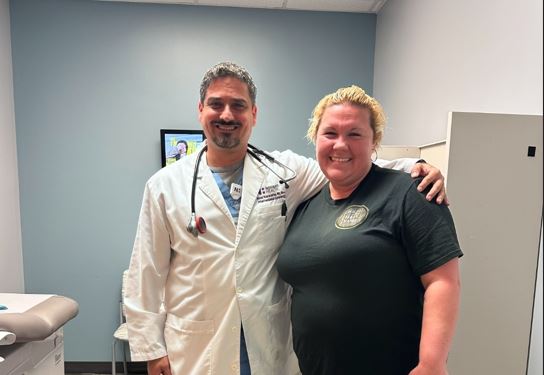
“Dr. Noureddine is so calming that I wasn’t scared at all about the procedure,” Lawson said.
That is, except for one aspect of it. The patient needs to be awake for the procedure.
“The whole team was amazing,” Lawson said. “I don't know who was holding my hands the whole time, but they were amazing. Every nurse and CNA on 6 West [the area of the hospital where she was treated] were my advocates. And for Dr. Noureddine to call after hours to check on me meant a lot. It was mind-blowing to me that a surgeon called to check on me.”
While most people have renal denervation as outpatients, Lawson stayed in the hospital overnight as a precaution due to her other medical conditions.
The catheter used in the procedure is connected to a module that gives the surgeon feedback. So, Noureddine knew the ablation had been successful. Still, it can take up to three months for the patient to see the full results.
Lawson saw them even sooner. Her blood pressure is averaging about 128 over 80 — or “all but perfect,” she said. She’s been able to eliminate all but one of her blood pressure medications, and her goal is to come off that last one in short order.
Her excellent blood pressure readings are especially gratifying since she and her husband are in the midst of selling their home and buying a new one.
“If my blood pressure can be this good during all this stress,” she said, “I'll take it.”
An hour-long procedure; results designed to last a lifetime
A surgeon explains renal denervation
Dr. Nizar Noureddine wasn’t nervous about performing the first renal denervation at Novant Health Forsyth Medical Center. He was excited.
“This is truly my passion,” he said. “It’s like playing video games. It's really fun for me.”
He’s long been interested in treating hypertension, he said, “because it's a huge disease state in the U.S.” About 122 million Americans, or 47% of adults, are estimated to have the condition.
This procedure may be new, but it’s not markedly different from other procedures he performs regularly. “I do radio frequency ablations for varicose veins in the legs,” he said, “and this uses the same kind of methodology. But instead of the legs, this is the kidney artery.” (While this procedure isn’t related to kidneys, the nerves surrounding the kidneys play a role in regulating blood pressure.)
The big difference is the catheter used. Other ablation catheters are straight; the one used for renal denervations is spiral. The surgeon inserts the catheter through the groin and pushes it up to the renal artery. When the spiral reaches its destination, the surgeon begins to ablate the nerves around it by sending ultrasound pulses to the target.
“You burn the fat around the artery,” Noureddine explained. “Within the fat, there are nerves. It can take up to three months for those nerves to die.” That’s why surgeons tell patients they may not see the full results until three months post-op.
Patients are cautioned not to drive for 24 hours after the procedure and not to lift anything heavy for about five days afterwards. But otherwise, they have no limitations.
Noureddine calls this a “one-and-done” procedure. The results should last a lifetime.