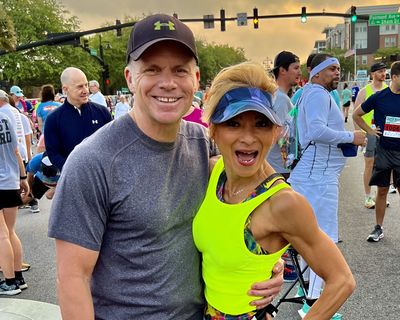
Minnie Hughes will never forget April 1, 2023. That’s the day she competed in the Cooper River Bridge Run and found out she had Stage 3 breast cancer.
Hughes, who lives in Charlotte, is a serious runner — she’s even competed in the Boston Marathon. But she ran the 10K in Charleston, South Carolina, just for fun, and to spend time with her big, close-knit family. Her husband, Tom, and her four siblings all came to town for the race.
The diagnosis was a gut punch to a woman who, at 59, is healthy, active and diligent about getting annual mammograms.
After Hughes got over the initial shock and fear, she took on cancer the way she might train for a race. And with support from her family and friends, her nurse navigator, Vicki Davidson, and her students at the YMCA, she got through treatment and now supports other women through breast cancer. Here’s some of what she learned.
Receive compassionate support throughout your breast cancer journey.
1. Get regular cancer screenings.
Hughes gets a mammogram every year. In fact, she had one just eight months before her ob-gyn found three lumps in her right breast. And the mammogram was clear.
2. Don’t skip your annual checkups.
During her annual wellness visit with her OB-GYN, Hughes’ doctor felt three lumps during her manual breast exam. She referred her for a diagnostic mammogram and biopsy the next day.

3. If you’re expecting results from a biopsy, scan or other test, resist the urge to look at MyChart. Let your doctor explain what it all means.
Hughes was told she’d get an email in three to five business days telling her the results were available in the MyChart portal.
Her husband suggested she avoid checking the results if they came while they were in Charleston. “Let’s just enjoy the weekend,” he said. But Hughes was convinced she didn’t have cancer. She thought she’d look at the results and be relieved.
Instead, she couldn’t understand the medical language written by a doctor that was intended for another doctor. Without some medical knowledge, the text may as well have been Greek.
Hughes took a screenshot of the results and texted it to a niece who used to work for Dr. Peter Turk, an oncological surgeon with Novant Health Cancer Institute - Elizabeth (Breast Cancer) in Charlotte. Soon enough, Turk would be Hughes’ doctor.
Her niece called immediately to ask: Whose biopsy results are these?
Hughes said, “Mine,” and her niece had to tell her: “It's cancer.’”
Things moved at warp speed after that. Her niece called Turk, who got Hughes in quickly, ordered tests and told her she had Stage 3 invasive ductal carcinoma.
4. Ask questions. And don’t be afraid to follow up.
Turk outlined Hughes’ options, which included surgery, radiation and possibly chemotherapy and hormonal therapy. He reviewed surgical options for her case which included lumpectomy (also known as breast conservation) vs. mastectomy. She recalled him saying, “I can’t tell you what to do.” But he gave her options and his recommendations.
Hughes’ main consideration was the survival rate. She asked if that rate was markedly higher for one versus the other. Turk told her that many women choose a mastectomy for peace of mind. But even a mastectomy doesn’t mean cancer won’t come back.
Knowing that, a lumpectomy made the most sense to Hughes. “I didn’t want a long recovery,” she said.
5. Share your news in a way that’s right for you.
Since all of Hughes’ siblings were together when she got the news, she told them, one by one, in person. But she couldn’t find the words to tell her parents.
So, she asked her sister to call their mom. “Of course, they were both crying,” she said. “And my sister told Mama: ‘Don’t call Minnie right now; she’s still trying to process this.’”
When Hughes called her adult son to tell him, her husband was with her so he could chime in if Hughes became too emotional to continue.
6. Be flexible. And be patient.
Cancer requires both.
Hughes hoped to avoid chemo. Like many women, she didn’t want to lose her hair. She had to wait for test results to know if chemo would be part of her treatment plan. She was relieved it wasn’t.
Less than a month after her diagnosis, Hughes had a lumpectomy. Three days after surgery, Turk called with unwelcome news: He needed to perform another surgery due to a positive margin, meaning not all the cancer was removed.
The tumor was larger than indicated on her breast MRI, and she would need additional surgery to ensure all the cancer was removed.
“I have implants,” Hughes said. “Dr. Turk said they needed to come out so he could ensure he got all the impacted tissue.” She was unconcerned, at that point, with the implants. Her priority was getting rid of cancer.
He performed a wider lumpectomy, which removed all of the cancer. She would then move on to a six-week course of radiation.
7. Stay active.
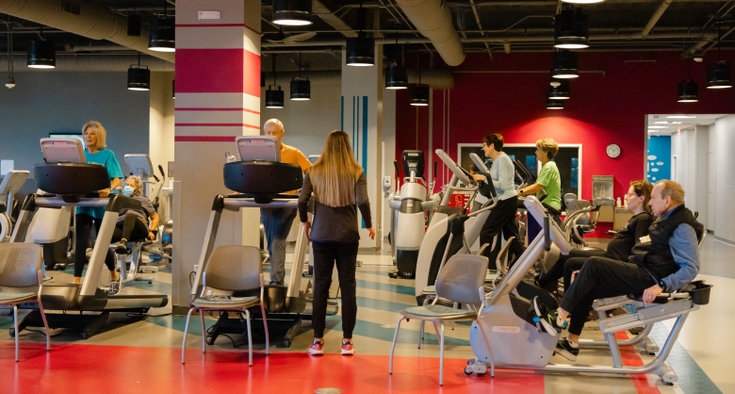
It was important to Hughes that she maintain as much of her routine as possible. Even with radiation appointments every weekday, she continued to lead strength training and cycling classes at the YMCA —sometimes with her husband’s help. She also continued her work as a personal trainer and her other part-time job in sales.
“I needed to be around people,” she explained. “That helped me mentally. There was one day I stayed home, without leaving the house, and I felt like I was sinking into a depression.”
In her 10 years as a Novant Health breast nurse navigator (and almost 20 years as a nurse in Turk’s oncology clinic), Vicki Davidson has seen how staying connected to everyday routines can help patients emotionally. “With the demand of many oncology appointments after a breast cancer diagnosis, patients benefit from holding onto parts of their routine and finding aspects of life that they can still control.”
8. Find your tribe.
Hughes appreciated the support she got from family and friends but said it was especially helpful to “talk to other women who’ve gone through, or are going through, a similar diagnosis.”
Davidson was another key member of her inner circle. “I absolutely wouldn't have made it without Vicki,” she said.
9. When people offer to help, let them.
Davidson, like other oncology nurse navigators, is available to help coordinate medical care, answer medical questions and navigate to appropriate support services.
10. Tell people what you need from them.
Hughes needed support and wasn’t afraid to ask for it. Other women may not be as comfortable being an open book. “Do what feels right to you,” she advises.
When Hughes told her YMCA students about her diagnosis, she added: “I don't want you to be upset for me. What I need from you is your strength.”
After class, every student hugged her. Some asked for her phone number so they could stay in close contact. She told them: “I’m going to lean on you for however long it takes to get through this.”
Hughes was especially touched when the women in her class began telling her that as a result of her sharing her news, they had gotten mammograms they’d been putting off.
11. Try to maintain a positive outlook.
“It’s all about attitude,” Hughes said. “I had my woe-is-me moment when I first found out I had cancer. But then I resolved to stop feeling sorry for myself. Self-pity wasn’t going to change the fact I had cancer. It wasn’t going to help. But a good outlook, and leaving it in God’s hands, would.”
12. Have a mantra. Or two.
The night she got the news, Hughes asked her husband if he was scared. “Of course, I am,” Tom told her. “But we’re going to take this one day at a time.” She reminded herself of that daily.
And another phrase she repeated to herself often: It could be worse.
“That was my motto through the whole thing,” Hughes said. When she was suffering side effects from a medication, had burns from radiation, lost her appetite and lost weight she really couldn’t afford to lose, she told herself: “It could be worse.”
Even when she couldn’t imagine what “worse” might look like, she told herself she was lucky to feel well enough to leave the house and go for a run.
13. Be prepared for the long haul.
Hughes finished radiation treatment in August 2023, but that wasn’t the end of her journey. “I’ll always have this fear of the unknown,” she said. “I’ll always be hoping it doesn’t come back.”
She’s on two drugs designed to prevent a recurrence. One of them — letrozole (brand name: Femara) — affects her bone density. So, she has iron infusions every six months.
She’s learned that cancer is like a rude house guest that overstays its welcome. Accepting that helps her stay positive.
14. All that help offered to you? Pay it forward.
“Minnie is a friend and a source of comfort for many others,” Davidson said. “Her dedication to living a healthy, balanced life is a clear sign of her resilience, hope and courage.”
One of the YMCA students who supported Hughes is currently going through a recurrence of breast cancer, and Hughes is returning the kindness.
“Minnie shares her story so openly,” Davidson continued. “She promotes preventive health, self-care, regular exercise, balanced nutrition and living life to the fullest. Despite experiencing normal anxiety and fear at times, she models resilience and demonstrates that, by facing those uncomfortable feelings, hope and joy can still thrive.”