

Back pain is one of the most common medical problems because there are so many ways to cause it. These can include falling, overextending during a workout, just twisting and lifting the wrong way, or even sitting for too long.
But the good news is that back pain – which affects people of all ages – can often be treated without surgery or medication. When problems develop in the spine, discs or back muscles, physical therapy (PT) can also help improve coordination and flexibility.
That’s where a licensed physical therapist comes in. These professionals take an active role in recovery by helping patients strengthen their posture, core and overall health. They’re there to not only help the patient heal, but to come back stronger.

Lately, physical therapists are seeing a surge in back pain because so many of us are sitting all day at work or in home offices, said physical therapist Cory Hustad of Novant Health Sports Performance & Rehab - Clemmons.
“We used to see people who were throwing around a lot of weight on the docks or out on the farm,” Hustad said. “But now it’s because people sit at a desk all day. Sitting is the new smoking. We were designed to move.”
Wondering if PT is right for you? Contact your primary care doctor or an outpatient clinic near you for an appointment. Both North Carolina and South Carolina allow direct access to PT, meaning you can be evaluated and treated by a licensed physical therapist without a doctor’s referral. However, some insurance plans, including Medicare and HMOs, may require a referral for payment.
Here, Hustad explains how back pain can benefit from meeting with a physical therapist.
Advanced treatments to help you move more easily.
Physical therapy has advanced over the years.
Some people get nervous or hesitant about PT, because they’ve heard PT can be painful. Sometimes you need to work through discomfort, but pain is not always the gateway to getting better.
There’s a misconception that patients come in for an ultrasound and a hot pack. That happened back in the 1980s, but we’ve moved away from a lot of that, based on treatment research. Today, depending on the patient, we might pursue dry needling, trigger-point release or scar-tissue massage to treat back pain. Based on what you’re experiencing, we can modify things like your work ergonomics and sleeping positions.
Just get moving.
This is the opposite of a workout: doing your laundry, going grocery shopping, or staying active in the yard or garden. You don’t have to lift heavy weights. Just getting moving increases blood flow, bone density and muscle tone, all of which are valuable especially as we get older.
Listen to your body.
A warmed-up body is much less prone to injury. Going for a walk is the easiest thing to do and requires no special equipment. Tai chi or qigong (pronounced “chee-GUNG;” a precursor to tai chi) are good for learning slow, controlled body movements that don’t exacerbate back pain. Most of us are going to experience back pain at some point. But you should seek treatment if it persists for more than a couple of weeks.
Take the first step to better back and neck health.
Don’t forget about balance.
When we don’t take part in activities that test our balance, it can decline sooner than we might expect. In order to get stronger, you must increase resistance. This can be done by using resistance bands, weight machines, free weights, a weighted vest or static holds, like planks. Improving your balance means safely challenging yourself.
For example: If you can’t stand on one leg, can you stand with both feet close together while tolerating some body sway? If so, start with maintaining that narrow base of support for a set time until you can progress to stand on one leg. Your body will usually adapt to progressive challenges.
As we age, exercises like yoga, Pilates, tai chi and qigong are all good for strengthening your core and helping with balance and flexibility. Motion is lotion, as we like to say, and it’s the quality of the movement that matters.
Core strength comes from hip, lower back and abdominal strength. Think of your core as a tin can; the top is the diaphragm, and the bottom is your pelvic floor. There are breathing techniques that help with the functioning of both, and we have physical therapists dedicated to this.
The worst way to respond to back pain? Stop moving.
Rest can be beneficial. But it can also be bad because your muscle tissue will atrophy, or deteriorate, rapidly. You will lose muscle mass very quickly if you lie in bed for a day or two. Sometimes we need to do that to recover from an illness.
But if we have back pain that incapacitates us, we need it treated as quickly as possible so we don’t experience more bone and muscle mass loss.
He fixes pain — and sometimes finds something more
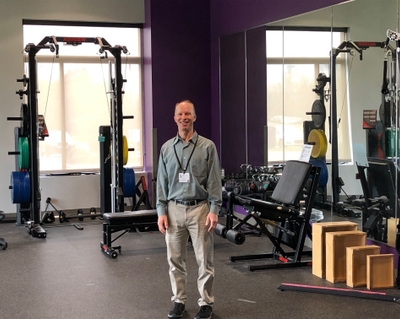
After graduating high school, Cory Hustad was stuck on what to do next. He liked science, anatomy and math. But the last thing he wanted was to sit behind a computer all day.
When he found himself reading about rotator cuff injuries to fix his own pain, Hustad had his answer.
A physical therapist since 1996, Hustad is also a certified athletic trainer and holds a master’s degree in business administration. Physical therapists like Hustad must also earn a Doctor of Physical Therapy degree, which is an intensive, three-year discipline.
Hustad is also fellowship-trained in orthopedic manual therapy, which is extra training that not every physical therapist completes.
“We’re not medical doctors, but we do have high-level training,” he said. “A big part of what we do is looking for symptoms beyond pain.”
These include red flags that suggest a serious medical condition like a compressed nerve or inflammatory arthritis.
“If I believe a patient is showing symptoms of cancer, a kidney stone or systemic inflammation, my job then is to get them seen by someone whose scope of practice will help,” Hustad said. “I don’t need patients to see me over and over again. What I want is to get them back to being active and healthy.”


