

A C-section is the most frequently performed major surgery in the United States — but many are misinformed about what really goes on in the operating room. Even if you’ve had a C-section, you may not know all the details of the procedure.
Novant Health ob-gyn Dr. Melissa Davies offers insight on some of the most frequent misconceptions about C-sections.
Myth No. 1: A C-section is an 'easier' way to give birth than a vaginal delivery.

Truth: In a C-section, you give birth plus have a major abdominal surgery, all at the same time. It’s a significant surgery that can be painful and requires additional recovery time for healing of the abdomen.
Yes, women who have a planned C-section may avoid the intense labor and contraction pain of vaginal delivery. But some women are in labor first before requiring a C-section, and those women experience the pain of labor as well as the recovery of a C-section.
Whether a C-section is planned or not: You have surgery, face the risk of surgical complications, experience discomfort and possibly pain, and have limited mobility, all while caring for a newborn baby. It’s not “easy.”
Find the maternity and ob-gyn care you deserve.
Myth No. 2: Your stomach muscles are cut during a C-section.
Truth: There are seven layers that are entered in a C-section: skin, subcutaneous fat (the fat layer under the skin), fascia (fibrous connective tissue that covers the abdominal muscles), rectus muscles (separated), peritoneum (membrane lining of the abdominal cavity), uterus and amniotic fluid sac. But contrary to popular belief, we don’t cut the abdominal muscles themselves — instead, we separate them and pull them aside so we can access the uterus. They’re moved, not cut.
Myth No. 3: You’ll be put to sleep for a C-section and won’t get to greet your baby.
Truth: In most cases patients are awake during a C-section, although the lower half of their body is numbed by a spinal block, an epidural block, or a combination of both. This means they can feel touch, pressure and sometimes discomfort — but not sharp pain.
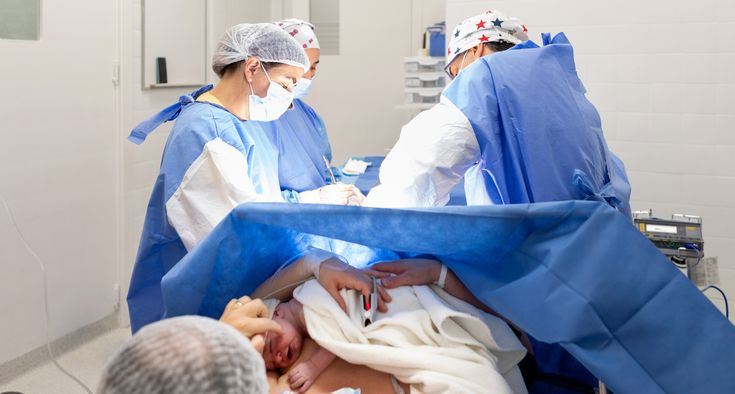
Once the baby is out and the team has made sure they’re healthy, we can put the baby on your chest for skin-to-skin time and breastfeeding immediately, even while we are still sewing up the abdomen. That’s part of why we put a sterile drape over some of your body before your surgery.
Sometimes under emergency situations we don’t have time to wait for a spinal or epidural block, so we put a patient under general anesthesia.
We do that very sparingly and only when needed to keep you, your baby, or both of you healthy. In this situation, you can breastfeed and do skin-to-skin in the recovery area as soon as you can sit up. If you aren’t ready, we’ll encourage your partner to start skin-to-skin with the baby until you are.
Myth No. 4: If you have a C-section, you won’t have pelvic organ prolapse or postpartum bleeding.
Truth: It’s common to have postpartum bleeding (called “lochia”) for up to six weeks after delivery whether you had a vaginal delivery or a C-section. Lochia doesn’t happen because you had a vaginal delivery. It happens because there is a fresh site where your placenta has detached from the uterus, kind of like if you had torn off a scab, and because your uterus is contracting and shrinking, pushing out blood in the process. Lochia happens regardless of your delivery method.
You’re also still at risk for pelvic organ prolapse — when one or more of your pelvic organs drop into or outside of the vagina — because you carried a baby and your pelvic floor has weakened. Women who delivered vaginally are probably at a higher risk than women who had a C-section, but it’s a possibility for both groups — and women from both groups could benefit from pelvic floor physical therapy after childbirth.
Myth No. 5: Doctors encourage C-sections so they can make more money.
Truth: There is a higher bill for a C-section, but that’s because C-sections require more resources — time, staff and an operating room — than a vaginal delivery. Your doctor doesn’t make significantly more money with a C-section than with a vaginal delivery.
There’s actually a movement in our country and at Novant Health to decrease C-section rates, because when possible, a vaginal delivery is generally better for mom and baby. The American College of Obstetricians and Gynecologists (ACOG) has clear guidelines and criteria for when we should become concerned about someone’s labor course, and we are really big about following them. We don’t want to put you through major surgery if we don’t have to.
If we do a C-section, our primary motivation is always safety for both mom and baby.
Myth No. 6: If you’ve had one C-section, you’ll have to have a C-section with any future babies.
Truth: It all depends on the type of incision your doctor makes during your C-section. The majority of the time, we use a low transverse incision to access your uterus. With this type of incision, you could potentially be a candidate to give birth vaginally in the future if you desire (called a vaginal birth after caesarean, or VBAC). If you want a repeat C-section in the future, that is also an option.
The low transverse incision is the standard of care and is what we plan to do, unless there is a medical need to do a different incision. If your doctor has to do a different type of incision, you may have to deliver by C-section in the future to avoid the risk of uterine rupture. This is another reason why we try to avoid C-sections, especially if it’s your first baby. If your doctor has to use a different type of incision, it’s to keep you and baby safe, and they’ll talk about that with you.
Myth No. 7: Elective C-sections are ‘unnatural, unnecessary or selfish.’
Truth: There are valid reasons why some women may need or request an elective C-section. They may have a history of previous birth trauma or a severe tear from a previous delivery, or have experienced trauma or sexual abuse that makes it hard to be in the labor and delivery environment. Sometimes, the baby is very large and it’s safer to deliver via C-section. A lot of the time, we recommend C-sections when there are twins or multiples.
I think there’s this idea that moms are scheduling elective C-sections for convenience, but I don’t see that happening in my office, especially with the counseling we provide about the risks of a C-section. Women who choose to do this really are choosing what they feel like is safest and best for their babies, and we support them.
Myth No. 8: A C-section is a failure.
Truth: A C-section is certainly not a failure. The pendulum has swung to where people push for this “all natural,” vaginal, unmedicated delivery, and then moms who require C-sections feel shame. We forget that historically, a lot of moms and babies would die before we had the ability to do a C-section.
You created this beautiful life, you carried this baby, and whether you push the baby out or not, a child is still being birthed. You’re a mom, you have a healthy baby, and that’s all that matters at the end of the day.


