

If you or someone you love has central sleep apnea, there’s an implantable treatment you should know about: the remedē® System, a device designed to treat moderate to severe central sleep apnea by helping restore the signals that control breathing during sleep.
Central sleep apnea occurs when the brain doesn’t consistently send signals to the muscles that control breathing during sleep. Unlike obstructive sleep apnea, which happens when the airway becomes blocked, central sleep apnea is caused by a problem with the brain’s breathing signals.

Cardiac electrophysiologist Dr. Michael Drucker of Novant Health Cardiology - Kimel Park Main is among the most experienced physicians in the nation in implanting the remedē System. The device is implanted in the upper chest and stimulates the nerve that helps control the diaphragm, prompting the body to breathe during sleep.
Novant Health Forsyth Medical Center in Winston-Salem was the first hospital in the Southeast and the first nonacademic medical center in the U.S. to offer the treatment. Drucker has performed remedē System implantation procedures for patients from across the Southeast.
Here’s what Drucker wants you to know.
Not sleeping well? Novant Health sleep specialists can help you get the rest you need.
First off: What’s an implantable device?
It’s a tool that’s surgically placed inside the body to help the body function. An example most people are familiar with is a pacemaker, which is placed in the chest to help regulate heart rate.
Now there’s an implantable device that treats central sleep apnea.
What is central sleep apnea and what are the symptoms?
During sleep, the brain sends signals telling the respiratory muscles to breathe in and out.
But when a person with central sleep apnea sleeps, their brain doesn’t send the right signals to tell the respiratory muscles to contract.
This causes breathing pauses (apneas) and shallow airflow episodes (hypopneas) many times an hour, and leads to:
- Frequent awakenings
- Waking up short of breath
- Restlessness during sleep
- Excessive drowsiness during the day
- Difficulty focusing and remembering things
- Morning headaches
- Irritability
How is central sleep apnea diagnosed?
Central sleep apnea is diagnosed after a sleep study, and described as “mild," “moderate” or “severe” based on the number of apneas and hypopneas that occur each hour during the study.
Restorative sleep is critical for mental and physical well-being. Without treatment, central sleep apnea can lead to severe fatigue, difficulty staying awake during everyday tasks, and serious health issues.
What’s the newer treatment option for central sleep apnea?
The remedē® System is an implantable device that’s approved by the Food and Drug Administration to treat adults with moderate to severe central sleep apnea.
The way Drucker explains it to patients is, “it’s like a pacemaker for your lungs instead of your heart.”
While you’re sleeping, the device continuously monitors your breathing. When you would have had a natural breathing pause, the device delivers electrical stimulation to your phrenic nerve, causing your diaphragm to contract and you to draw in a breath.
This approach is called phrenic nerve stimulation. The goal is more normal breathing, fewer apneas, and a better night’s sleep.
How is phrenic nerve stimulation different from other treatment options?
The other main treatment for central sleep apnea is positive airway pressure therapy — wearing a mask connected to a machine that pumps pressurized air to keep the airway open and keep breathing more normal during sleep. Examples include adaptive servo-ventilation (ASV), bilevel positive airway pressure (BiPAP), or continuous positive airway pressure (CPAP).
But some people don’t like the mask or have problems keeping it on at night. Phrenic nerve stimulation offers a mask-free approach.
What is the remedē® implant procedure like?
The device has to be implanted before treatment begins. To do so, an electrophysiologist like Drucker will make a roughly 5-centimeter incision in the upper chest and place the device under the right collarbone. Then they’ll place a wire from the device through a vein that connects to the phrenic nerve. This is all done under anesthesia.
“Then we wake them up, test the wire, and put them back to sleep when we’re satisfied that the wire is stimulating the right area and not causing pain,” Drucker said. Then the patient is sewn back up.
The whole process takes one to three hours depending on the patient’s anatomy. Most patients go home the same day as their procedure.
For the next 6 weeks, they can’t lift anything heavy or raise their right arm higher than their elbow while they recover.
Can I see or feel the implanted device once it’s inside me?
It depends on your body size and shape: “It’s a very similar scenario to a pacemaker,” Drucker said. “If you’re a bigger person, you may not feel it or see it, but in a smaller person, it leaves somewhat of a footprint.”
When does the remedē® device begin working?
About 4 to 6 weeks after the device is implanted, the doctor “turns on” the therapy.
“We start low and slow,” Drucker said, since the stimulation can take a little bit of getting used to. Over a few months, settings are adjusted based on patient feedback and data recorded by the device.
“I warn the patients that we might not hit the sweet spot on programming the first time through, but just be patient and we’ll eventually get the program tailored correctly,” Drucker said. “When the device works, it works.”
How can I learn more about the remedē® System?
If you haven’t been diagnosed with a sleep disorder but have symptoms of one, talk with your primary care provider.
If you’ve been diagnosed with moderate to severe central sleep apnea and a mask-based therapy isn’t working for you, tell your sleep medicine provider that you are interested in the remedē® System.
“When they get to me, most people are very symptomatic and are desperate to have some sort of treatment that they can tolerate,” Drucker said. “But when their sleep apnea is treated, it's a life changer.”
After treatment, he’s a morning person.
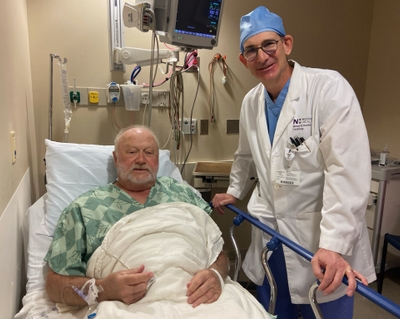
Ten years ago, a sleep study showed that Howard Spangler was having over 40 apneas, or temporary pauses in breathing, per hour.
A CPAP machine didn’t eliminate them. A BiPAP machine wasn’t much better: “I would wake up three, four, five times a night to deal with my BiPAP mask,” Spangler said. “A lot of times I couldn’t get back to sleep because of dealing with that BiPAP machine.”
When Spangler heard about the Inspire implant — an implantable device that was FDA-approved in 2014 for some cases of obstructive sleep apnea — he was ready to sign up. That is, until he learned that over half of his breathing events were from a less common form of sleep apnea called central sleep apnea, which the Inspire device does not treat.
Spangler was disappointed, but kept his ears open for a similar development for central sleep apnea.
So when he heard about the remedē® System, Spangler was intrigued. He already had two artificial knees, an artificial shoulder, and a spinal cord stimulator that had helped him get his golf game back — “anything that will help and get me to where I can function.” Could an implantable device possibly help 73-year-old Spangler wake up with energy again?
Cardiac electrophysiologist Dr. Michael Drucker of Novant Health Cardiology - Kimel Park Main thought so. And once Spangler got his questions answered by Drucker and the remedē® team, he hoped so too.
In March 2026, Spangler had the device implanted — and after a recovery period, it was turned on.
A few months in, “I don’t have any problems with waking up in the night anymore,” Spangler said. “I’m so much more alert and clear.”
He used to sleep in. “Now, I’m up before my wife and my dog every day,” Spangler said, “and it’s completely different when I get up — I’m not near as lethargic and slow to get started, and I have more energy.”
As part of their retirement, Spangler and his wife regularly travel from their home and farm in Lexington, N.C. to Myrtle Beach, S.C. He used to pack his BiPAP machine and its cleaner — “now all that stuff is stored away in the closet,” Spangler said.
The bulge in Spangler’s upper chest from the device has started some conversations. Spangler tells people: “I have nothing but accolades for it — it has not done anything that’s detrimental to my sleep, and has done nothing but help my sleep.”
“I used to dread going to bed because I had to put that dadgum BiPAP on,” Spangler said. “Now I know I’m sleeping better and I don’t have that dreariness when I first wake up in the morning. I’m sure I’m a much nicer person — in the early hours, anyway.”


