


As career pivots go, it might be hard to top the story of pediatric surgeon Dr. Heather Nolan with Novant Health Pediatric Surgery - Elizabeth in Charlotte.
She was working behind the camera as a director and producer at a pair of low-power TV stations (WBQC and WOTH) in Cincinnati when the seeds of change began to sprout. She’d been out of college for a few years when it began to dawn on her: There’s something else calling me.
She’d been volunteering at a hospital — first in the gift shop, then with patients. About the same time, she was hooked on “Doctor 90210,” a reality TV show that took viewers into the OR. “It showed me the impact surgery could make in patients’ lives,” she said. “And I thought: This is for me. I told my husband, Matt, ‘I think I want to be a doctor,’ and he said, ‘Let’s go.’”
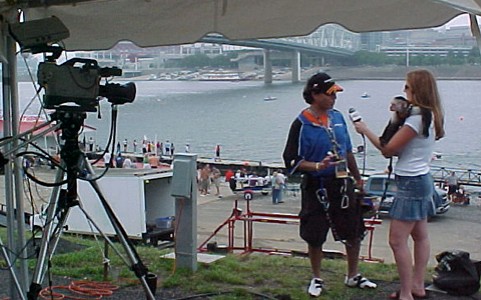
She left her job in TV and started working full time at the hospital where she’d been a volunteer. During the day, she worked as a nurse’s aide, making beds and helping patients with bathing and using the bathroom. At night, she took classes at a local community college to fulfill her science requirements for medical school admission. She took the MCAT and was accepted to the University of Kentucky College of Medicine.
Once Nolan was in medical school, she continued to be drawn to surgery and chose to enter general surgery residency. There, she was exposed to the field of pediatric surgery and found her true passion. She realized “pediatric surgery was exactly where I needed to be.”
(The Healthy Headlines editorial team will take a moment to note: Almost no one with a communications background decides to become a physician/surgeon and then exhibits the chops to march into that new career as if it were the most natural thing in the world.)
Get the best possible surgical outcome for your child.
Years — and years — of training
There were other doctor paths that Nolan could’ve chosen that would’ve taken considerably less time and effort. But she knew what she wanted and was willing to put in the work. In addition to four years of undergraduate school, Nolan went to:
- Four years of medical school at the University of Kentucky College of Medicine.
- Five years of training in a general surgery residency at Mercer University in Macon, Georgia.
- Two more years in a fetal surgery fellowship at Cincinnati Children’s Hospital, which she did while she earned a Master of Science degree from the University of Cincinnati.
- And that still wasn’t enough. After that, she had two more years as a fellow in pediatric general surgery at Johns Hopkins All Children’s Hospital.
Some of her medical school colleagues had already been working for over five years by the time she finally began her career. But the opportunity to take care of children was worth those 13 years in training. “I absolutely love my job,” she said. “It’s a lot of training and a lot of work, but it helps prepare you for anything that might come your way.”
And coming into the field from another line of work may have had its benefits as well. “Having that background where I started somewhere else was harder, probably,” she said. “But I felt like it gave me an experience that was unique and made me a better overall doctor.”
Ready for anything
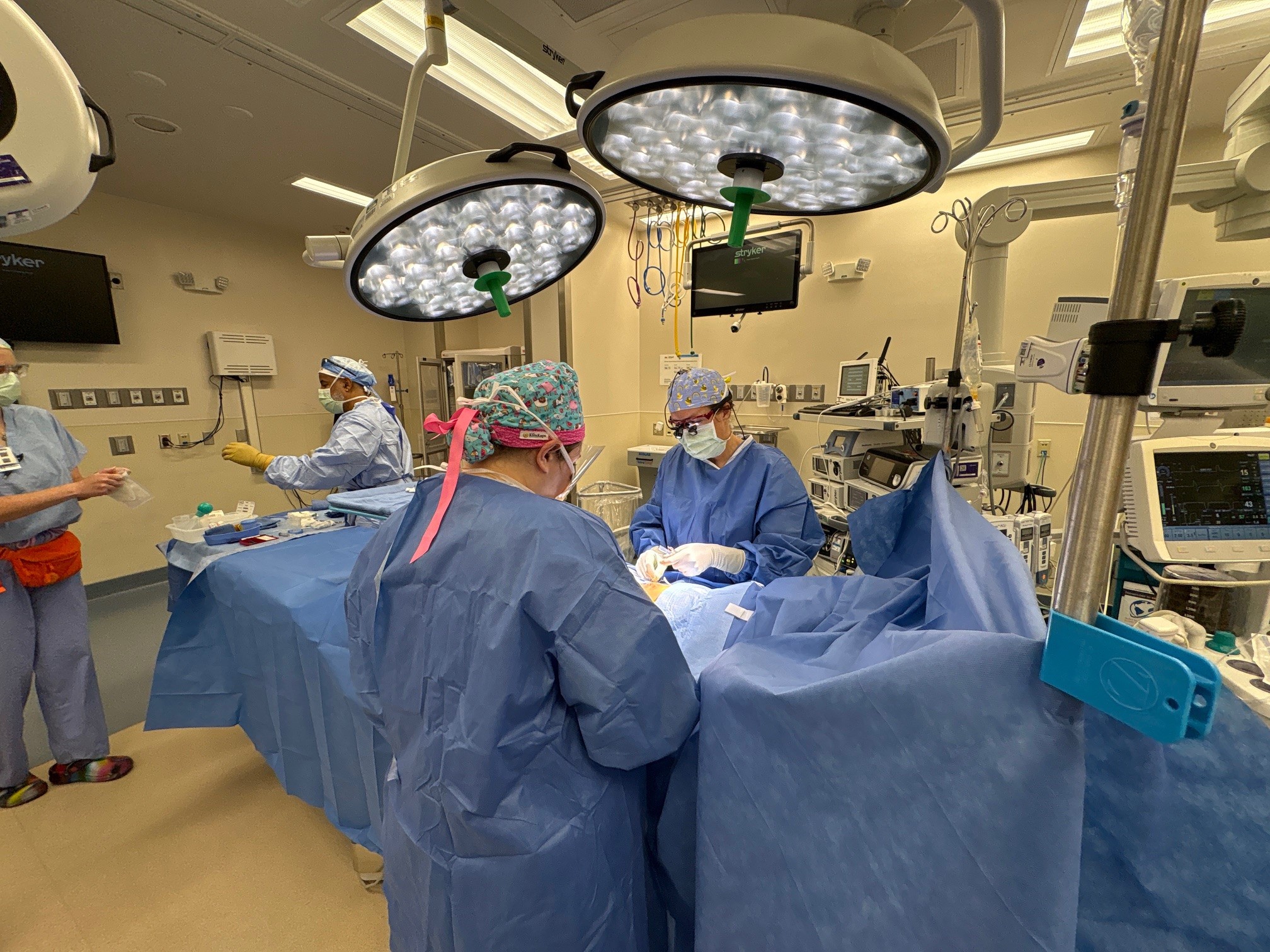
And pediatric surgeons have a lot come their way. So when Nolan is called upon to operate on, for example, a baby born without an anus or a baby born without the intestines connected to one another, it’s nothing she hasn’t seen before.
Complex surgical cases — including being on-call for emergency surgery — are all in a day’s work for Dr. Nolan and partner Dr. Tuan Pham. (Read more about their practice at this recent Healthy Headlines story.) The complexity, she explained, can be a result of several factors. In some cases, it’s related to the size of the patient. For instance, she has operated on a baby who was born two months premature and weighed just over a pound.
In other cases it’s the process, such as the inherent challenges in creating an anus where one doesn’t exist. And even though she’s performed procedures like these before, everyone’s anatomy and the way in which they present is slightly different. So, every surgery — even when it’s one considered “routine” — is unique.
Not that Nolan considers any surgery routine. She always tries to imagine what the parents of a child who might need surgery are feeling. “I tell all my families that there’s no small surgery when it's on someone you love,” she said. “We treat every surgery as a big surgery, like it’s one in a million.”
Taking the fear out of the unknown
Nolan’s clinic in Charlotte opened in June, so it’s still new. But already, the team has created an environment that’s fun for kids to visit.
Nolan said, “As a big kid myself, I really like it!” Plus, she added, “The team feels like family.
“We’re all pediatric-focused,” she said. “And our team has specialized training relating to kids and teens, which really makes a difference when it comes to taking something as big and unknown as surgery and making it easy to understand.”
And her journalism background doesn’t hurt, either.
It’s what helps guide her conversations with patients and their parents, who might notice — and appreciate — that her speaking style is mercifully devoid of medical acronyms and “doctor speak.” Nolan’s pivot from TV to MD was a boon for her — and her patients.
From television control room to the OR
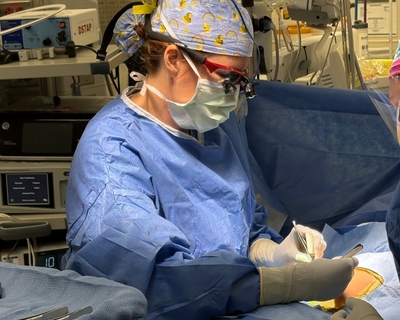
Dr. Heather Nolan’s time in radio and TV didn’t go to waste. Those skills help her in both the OR and in consulting with families.
For instance, cameras factor into both her current and former careers.
“In my first career, I was in the background saying, ‘Go to Camera 2’ and ‘Go to commercial,’” she said. “Now, I do a lot of laparoscopic surgery, which is surgery with a camera. Obviously, it’s a very different camera from the ones I worked with before. But it’s nice to be able to understand things like white balancing.” (That’s a camera setting that adjusts colors to ensure white objects appear truly white and corrects color, if necessary.)
She used to also produce all the promotional ads for the station. “I loved the production part, but I hated selling,” she said. “I’m not a salesperson.” She doesn’t have to sell anything in her role as a surgeon.
But she does have to simplify the complex and explain, in simple terms, surgical procedures — something that comes naturally to her. She said, “My journalism background helps me break complicated things down into something easy to understand.” And for her, communication is more than just a previous career; it’s a principle she applies to her practice.


