

Getting orthopedic care doesn’t always mean seeing just one clinician. A doctor paired with an advanced practice provider (APP) — either a physician assistant (PA) or nurse practitioner (NP) — can cover more ground and offer more comprehensive care than either could alone.
In recent years, Novant Health orthopedic PAs have made it possible for many patients to get same-day care. Those patients can get appropriate scans, get a diagnosis and receive treatment. Most importantly, they can avoid the ER.

“Over the last few years, we’ve had a big push to make more same-day appointments available for people who need to be seen urgently,” said Dr. Timothy Ewald (EE-wahld) of Novant Health Orthopedics & Sports Medicine. “That’s true, not just in the Lake Norman area where we practice, but for all of Novant Health orthopedics. It’s been a huge point of emphasis for us to make access as easy as possible.”
And that’s been made possible, in large part, thanks to APPs. Physician assistants are APPs who train in medical schools and approach care through a medical lens. Nurse practitioners, who are registered nurses, approach care through a holistic lens.
Ewald practices in two offices in the Charlotte region, so he has two PAs — David Drago in Mooresville and Amanda Colon in Denver. We talked to him and Colon about their partnership and how it benefits patients.
Leading-edge orthopedic care, personalized for you and designed for convenience.
How they work together
Ewald: When there’s a higher level of complexity or if a patient may need surgery, then I'll definitely be involved. Surgery is the only reason a patient would need me and not Amanda or David. Anything short of surgery, a PA can handle. Because we work as a team, patients can get the service they need at different levels.
Our interest is in getting to the bottom of what’s causing the pain in order to fix it. We try not to rely too heavily on pain medicine; our job is to figure out what's going on and fix the issue.
PAs see a lot of patients independently. A huge part of our practice consists of patients who don’t need surgery but come to us for pain management. Amanda and David can generally see and treat those patients without my involvement.
David started working with us last November (2025). He’d been a PA for another local orthopedic group for about 16 years. So, he’s very experienced. He has a wealth of knowledge and is really solid.
Amanda started working with me about four years ago. She came from Long Island, New York, where she’d worked for another orthopedic practice. She has a really soft touch and an amazing demeanor that puts people at ease.
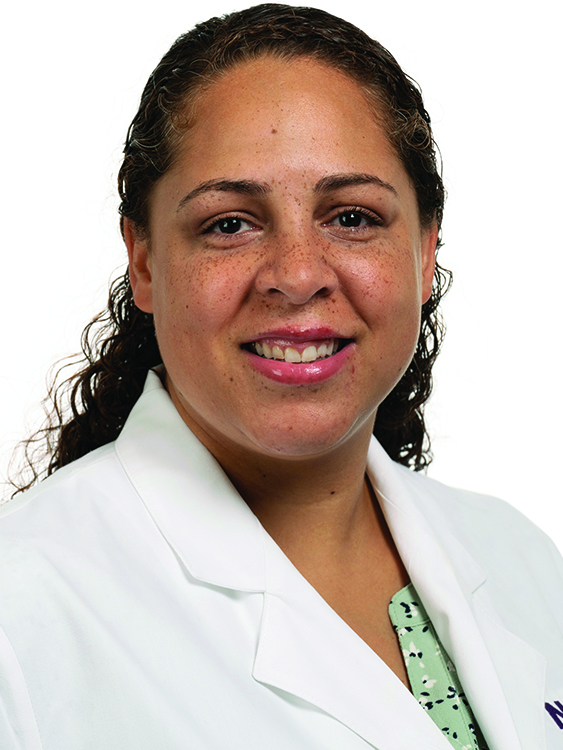
Colon: A doctor has to have trust in his PAs. Dr. Ewald trusts my abilities. He knows that the patient is going to get 100% from me. I'm going to listen, hear their concerns, help alleviate their pain. He and I are both committed to making our patients’ quality of life better. And, we're very detail-oriented. We even have a similar way of taking notes.
When I first started with Dr. Ewald in 2022, we worked the same schedule. But his practice has expanded so much. He’s confident in my level of patient care. So, he offered me the opportunity to do an independent clinic alongside him. I started with a lighter patient load but worked my way up to a full schedule.
I have my own patients, but when I’m less busy, I can help with his. I can start the process — get the history, the physical and then give him my thoughts. We’ve gotten into a good groove.
Teaming up in the operating room
Ewald: In the OR, PAs help with draping and getting the patient positioned. Once we start surgery, they’re assisting me in whatever ways I need.
Colon: I’m in surgery on Mondays and Fridays, and Dr. Ewald’s other PA, David, is in surgery on Wednesdays.
I like to be in the operating room before a patient goes to sleep. There can be a lot of unknown faces there, which can lead to anxiety. I’ve had patients tell me, “The only thing that's going to give me comfort is knowing you're there that day.”
Once Dr. Ewald is operating, I’ll do whatever he needs to ensure the surgery goes smoothly.
Coordinating in the clinic
Ewald: PAs become almost like a doctor’s right hand. I have complete confidence in Amanda and David. I trust both of them to work independently. In clinic, they might get a patient’s history, do a physical exam, order appropriate imaging like X-rays, MRIs and CT scans. They do casting, bracing and injections.
Colon: Since PAs can do nearly everything physicians can except perform surgery, I’m able to help Dr. Ewald make good use of his time.
We prescribe medicine, give cortisone injections for pain and treat fractures in pediatric patients all the way up to our geriatric population.
If we need to recommend surgery, that’s better for Dr. Ewald to handle. I can tell a patient about their MRI results and what they need to have done, but they’re ultimately going to want the surgeon to answer questions about surgery.
On the prevalence of PAs in medicine
Colon: When I started as a PA more than 12 years ago, I often had to explain my role. Now, we’re very widely accepted. People know about the profession. So, I do a lot less explaining.
Ewald: It’s not all that common anymore, but some patients used to insist on seeing a doctor. Some still do. But these days, most people are pretty used to the idea of PAs and nurse practitioners performing the less complex parts of care.


