Hudson Goose can hardly wait to tell his story. I ask his mother, Meredith, a basic question about the onset of an illness: When did the first symptoms appear?
Hudson, a loquacious, 9-year-old redhead with a cherubic face, responds immediately. He and Meredith sit side by side on a gray couch — the same one where, a little more than a year ago, he slept for days while his parents and doctors tried to figure out what was wrong.
But at this moment, he’s in class, he has the right answer, and he won’t wait for the teacher to call on him. “Oooh, I know exactly!” he exclaims. “December third!”
That day — Tuesday, Dec. 3, 2024 — Hudson went to school at Grand Oak Elementary, near the Gooses’ home in Huntersville, north of Charlotte. By late morning, he was coughing and had a sore throat. His father took Hudson to Novant Health Huntersville Pediatrics & Internal Medicine, where he tested negative for strep throat, flu and COVID. The pediatrician thought it might be bacterial pneumonia. She prescribed antibiotics and sent him home.
A week later, after two trips to the emergency department at Novant Health Huntersville Medical Center and another to Huntersville Pediatrics, an ambulance took Hudson to Novant Health Hemby Children’s Hospital in Charlotte.
He may have suffered initially from pneumonia. But by Dec. 10, his symptoms went far beyond any caused by bacterial infection. Hudson was limp, so weak his mother had to “piggyback” him wherever he went. He could barely move his limbs. His face had begun to droop. Most alarmingly, he struggled to breathe.

“I remember seeing him the day after he was admitted ... looking at him after our neurologist had seen him and not knowing exactly what this was,” says Hemby’s medical director, Dr. L. Eugene Daugherty. “But whenever we see weakness, especially in someone his age, one of our considerations is Guillain-Barré (Syndrome).
“I remember seeing him on the (main hospital) floor, and as soon as I saw him, I said, ‘He needs to come back to the ICU right away. He’s very sick.’”
The care you and your amazing child deserve
Birthday and Christmas in the PICU
More than a century after its discovery, the precise cause of Guillain-Barré Syndrome (or GBS, pronounced ghee-YAN bah-RAY syndrome) remains a mystery. Medical researchers do know that it usually emerges from some kind of infection, as the immune system “mistakes” peripheral nerves — those not contained within the brain or spinal column — for pathogens. Research has shown that GBS occurs in about one in every 100,000 children younger than 16.
The result is worsening weakness and fatigue, along with a “pins and needles” sensation in the fingers and toes. In the most severe cases, like Hudson’s, those symptoms presage paralysis. Another complication: GBS is a syndrome, not a disease, which can make diagnosis difficult. “It’s a constellation of findings as opposed to a single pathogen,” Daugherty says. But all of Hudson’s symptoms were consistent with GBS.
“He had such profound weakness lying in his bed. His arms were almost flaccid beside his legs,” Daugherty says. “What’s really profound in these kids is, it looks like they have no strength. They can’t smile, they can’t open and close their eyes. In essence, it’s paralysis ... not from a car accident but because the nerves are damaged.”
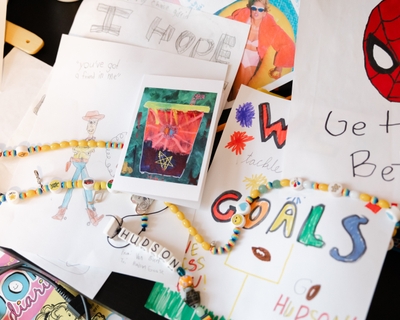
In the pediatric intensive care unit (PICU), Daugherty placed Hudson under sedation and inserted a breathing tube. Hudson would remain in that state for the next two weeks — missing his and his twin brother’s eighth birthday — as doctors tried to suppress his overaggressive immune system through high-dose steroids, immunoglobulin therapy and five rounds of plasmapheresis. That’s when the blood is drained from the body, infused with fresh plasma, and reinserted.
Hudson remembers little about the ordeal. Meredith recalls nights of fitful or no sleep and days of almost unbearable anxiety. She still had to care for Hudson’s brother, Miller, and older sister, Hailey; thankfully, Meredith’s parents came in from Ocean Isle Beach to help.
Over Christmas, the family stayed with Meredith’s brother, who lives near SouthPark Mall. Meredith went there for two hours on Christmas morning to celebrate and open presents with the family before she returned to the PICU at Hemby. Christmas Day or not, she couldn’t miss what was coming that morning: After two weeks, doctors were going to take out the breathing tube to see if Hudson could breathe on his own. At about 11 a.m., they did, and he did.
“I did feel like prayers were being answered, because we’d been waiting for him to get stronger and stronger, and finally it was like, ‘We’re going to do it. His body’s going to be strong enough,’” Meredith says. “I was just really grateful. It was like a little light at the end of that chapter.”
Hudson’s path to recovery
Hudson’s recovery has been slow, and it’s nowhere near over. He finally left the PICU on Jan. 2, 2025, and Hemby a week after that. But he had to go through 50 days of rehab before he could finally return home Feb. 28. The neighbors on his cul-de-sac in the Wynfield Forest community lined the street with welcome-home signs. “We were just bawling,” Meredith says.
Today, Hudson can walk again, although he gets fatigued easily, and his gait is what Meredith calls a “penguin walk,” unbalanced and uneasy. He does physical therapy twice a week and, as he did before GBS, swims regularly.
“Given that it’s been over a year already, it’s going to take months and months for him to get back to who he was,” Daugherty says. “I expect him to continue to make progress. I just think it’s going to be very slow. I think he’ll get there. But I think it demonstrates how severe his case was ... One of the most severe I’ve seen.”
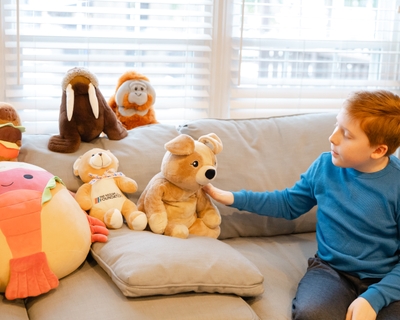
Still, Hudson no longer needs a wheelchair or walker, which was a necessity at home and school until November. (He does have enough energy to happily rush out to the garage to retrieve his walker to show me.) In December, a year and two weeks after he got sick, Hudson was the guest of honor at a Charlotte Hornets home game. He wore an orange LaMelo Ball jersey and marveled at the size of the Spectrum Center. “Mom,” he remarked at one point, “I see LaMelo!”
Hudson has only vague memories of his illness, even though he’s eager to tell people what he knows about it. “My mom started carrying me around the house because I couldn’t walk,” he says between swigs of an Oikos protein shake. “My mom would have to piggyback me up, down the stairs, every single day, to the bed, to the couch. But that’s when I realized, ‘Why aren’t my legs working?’ I was really confused, and I didn’t know what was happening.”
And now?
“Well, I’ve got three words for you.” Hudson’s math skills aren’t all the way back, either, but his voice and pitch make up for it. Out of nowhere and in tune, he belts out the first line of an old-school early-’90s jam: “I got the power!”