

All her life, Caitlin Creech knew that she wanted to be a mother. What she had no way of knowing is that for her, the path to motherhood would be at turns harrowing, heroic and, ultimately, deeply healing.
Caitlin and her husband, Matt, are now the parents of two little girls, Scarlett Delaney, 13 months, and Sloane Hadley, 8 months.
Both are their biological daughters. And the story of how they got here combines the compassionate care of Novant Health’s medical team, the selfless love of a best friend, and a twist that no one saw coming.
Exceptional care for you and your growing family.
Years of loss
Matt had children from a previous marriage, but he and Caitlin wanted to have a child together. Shortly after they married, she conceived and then, at six to eight weeks, miscarried. After that, it took a year and fertility meds for her to get pregnant again. The couple saw the baby’s heartbeat and then – a second miscarriage.
By now, Caitlin was in her mid-30s. Caitlin is a licensed practical nurse with Novant Health Carmel OB/GYN, working with a team that serves women through some of the biggest milestones of their lives. She knew that conceiving might be a challenge at her age.
Her ob-gyn, Dr. Sarah Morris, counseled her to move to a fertility clinic. There, testing revealed that Caitlin had antiphospholipid syndrome, an autoimmune blood disorder that can cause a long list of health problems, including infertility and miscarriage. With medication and monitoring, the Creeches proceeded with intrauterine insemination (IUI), a procedure in which a high concentration of washed, healthy sperm are placed directly in the uterus, timed with ovulation that can be boosted with medication. The IUI worked and Caitlin conceived.
“At 8 or 9 weeks, I’d been cleared and passed back to my ob-gyn,” Caitlin said. At the end of the first trimester, the couple went to the office for an ultrasound. There was no heartbeat.
"That was devastating,” Caitlin said. “A week before, there was a baby, and the next week, there was not.”
A startling offer
The couple went on to try multiple rounds of in vitro fertilization (IVF), in which eggs are fertilized by sperm in a lab and a resulting embryo is implanted back into the woman. Again, they attempted IUI. “None of it worked,” Caitlin said.
Caitlin suffered three consecutive miscarriages, three failed IUIs, and four failed IVF embryo transfers. What can’t be measured is the misery that she felt, as months became years.
And that’s when Caitlin returned to something her best friend of 23 years, Heather Davis, had told her after the second miscarriage. I could carry for you, Heather had said.
Heather was offering to become a gestational carrier, woman who carries an embryo created by IVF for someone else.
“I called her and I was super nervous,” Caitlin recalled. “I said, ‘OK … we pretty much spent our life savings on infertility treatments, and nothing has worked.’ And she was like, ‘Well, I’ll do it.’ I said ‘No, no, no — you need to talk to your husband and your boys. This is a huge deal. She said, ‘Caitlin, I will talk to them, but I don’t need to. I didn’t say it flippantly when I offered several years ago to carry for you and I know my husband and my boys want this for you, too.’”
Heather’s husband, Brandon Davis, supported his wife’s decision. “I have been head over heels in love with my wife for 15 years,” he said, “and this actually made me fall in love with her that much more.”
The two couples agreed on the plan, then spent six months in a medical and legal gestational carrier clearance process.
And then … surprise!
Right before the Creeches’ embryo was implanted in Heather’s womb, Caitlin noticed her cycle was off. She took a pregnancy test. Then, in shock, she took two more. All three tests agreed: She was pregnant.
“I hadn’t seen a positive pregnancy test for myself in two and a half years,” she said. She called her doctor. “She said, Caitlin, this is crazy and amazing, but given your history, let’s be cautiously optimistic.” The couples agreed: The surrogacy should go forward. The embryo transfer was a success — and, as it turned out, so was Caitlin’s pregnancy.
And then suddenly one night, Caitlin was hit with a headache unlike anything she had ever experienced. She checked her blood pressure and found it was alarmingly high. When it stayed that way overnight, Dr. Morris was adamant: You have to get to the hospital. Right now.
Matt drove her to Novant Health Presbyterian Medical Center, where she was diagnosed with preeclampsia, a condition that can be life-threatening for a pregnant woman and her baby. Any mother-to-be can develop it, and those with high-risk pregnancies get extra monitoring. Caitlin was 24 weeks pregnant, and a scan showed the blood flow to the baby was already compromised.
“I could tell by (Caitlin’s) face and the doctors’ faces that what they were telling us was serious, for her and our baby,” Matt said. “I knew that she was scared, so I was trying to stay calm for her.”
The NICU team from Novant Health Hemby Children’s Hospital arrived at Caitlin’s bedside to explain that if she could make it until 26 weeks gestation, the baby’s chances of survival would be much better.
“I was determined,” Caitlin said.
That meant Caitlin was admitted to the hospital and got care to try to control her blood pressure. The days inched by. Finally, at 26 weeks, Matt and Caitlin’s daughter, Scarlett Delaney Creech was delivered via C-section. She weighed 1 pound, 5 ounces. “She made a little cry, very weak,” Caitlin recalled. “The NICU team was waiting in the wings. They whisked her away and started working on her. She was put on a ventilator.”
Heather, about 19 weeks pregnant at the time, was there supporting Caitlin throughout.
Baby Scarlett stayed in the NICU for six months. Her family was with her every day and knew Scarlett was in good hands. “Scarlett's primary nurses, nurse practitioners and many therapists were amazing, and we are very thankful for everything they did for our girl,” Caitlin said.
One of things that sets the Hemby NICU apart from similar units elsewhere is that babies stay with the same care team during their entire stay. The care team gets to know each newborn’s preferences, what makes them calm and relaxed, and how to best interact with the baby.
“The babies that are here a long time we get very bonded with, as well as with their families,” said Phyllis Waddell, Hemby Intensive Care Nursery nurse manager. “The team is great about treating these children as if they are their own.”
Baby No. 2 arrives
While Scarlett was still in the NICU, Heather delivered the Creeches’ other daughter. Sloane Hadley — her middle name means “field of Heather” in Old English — was born full-term and healthy at Novant Health Matthews Medical Center.
The two friends said the experience was almost beyond words.
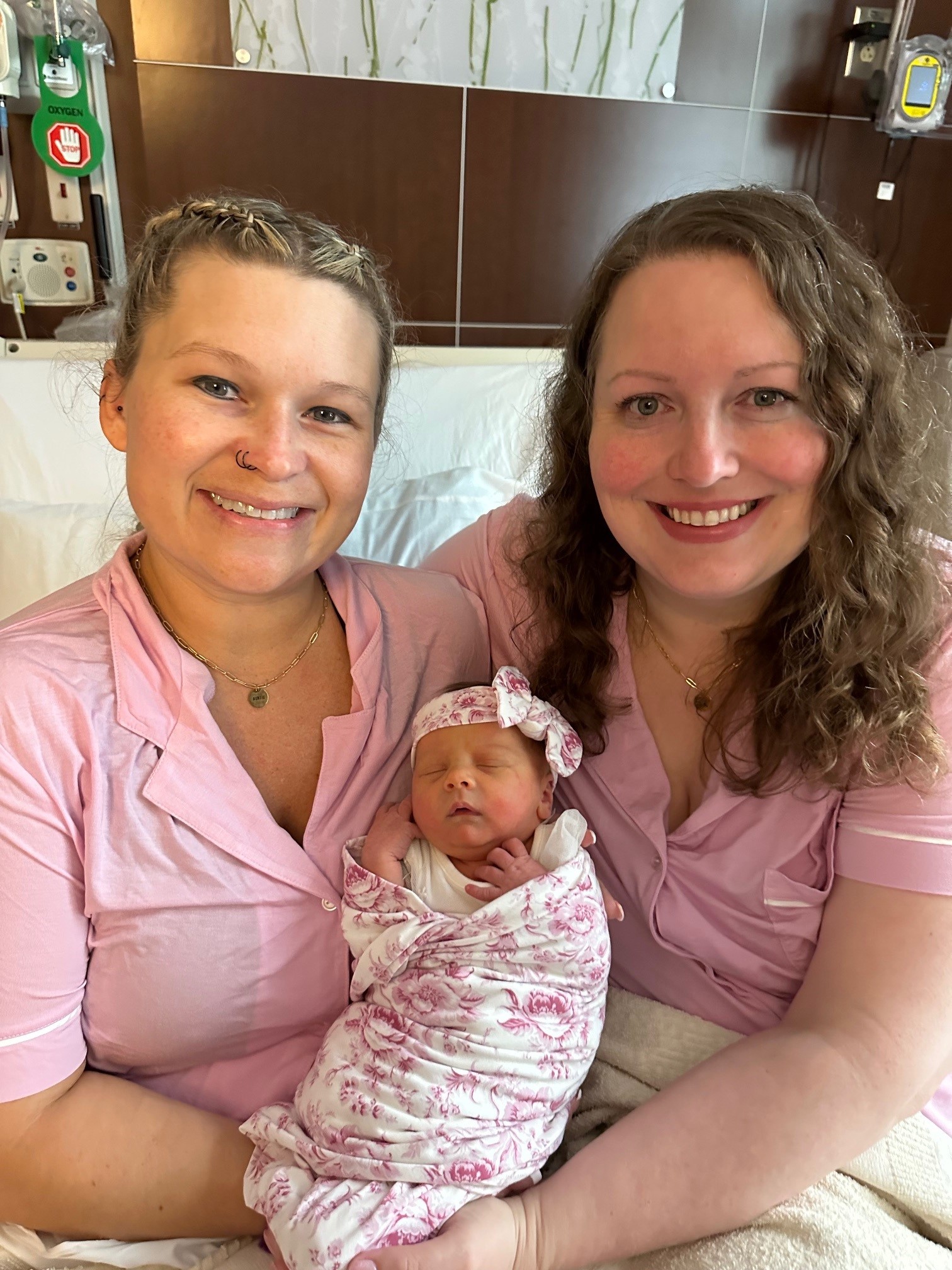
“It’s such an out-of-body experience to see your best friend doing something so selfless and amazing and beautiful for you such as bringing a child into the world,” Caitlin said.
Heather, who has two sons, had known she did not want more children of her own, and said that helped her have “a different relationship” to the baby she carried for Caitlin. “I’m going to be a part of her life forever,” she said. “I call her my ‘belly bestie.’”
Morris said serving as the ob-gyn for both women was a privilege.
“I’ve had patients who were surrogates before, but not where Mom was pregnant at same time and they were best friends,” she said. “It was just like one giant extended family. It was amazing and beautiful.”
For her part, Heather praised Morris and the care she received at Matthews Medical Center.
“When I was going to have my spinal (block) I was sobbing — I’m terrified of needles,” Heather said. “Dr. Morris went back with me, held my hand, and put her forehead against mine. The nurses I had were amazing. Everybody there knew our story and they were amazing.”
“Scarlett’s birth and NICU stay was more complex and scarier but Presbyterian Medical Center took great care of our family,” Matt Creech said. “Matthews Medical Center, where Sloane was born, was very accommodating and kind to both of our families and the situation. It was a very special experience for all of us.”
Today, both baby girls are thriving. Scarlett will be 14 months and Sloane 9 months in early May, and Scarlett no longer needs supplemental oxygen. “They’re giggling and excited about things,” said Caitlin. “They both came into this world by different means but they are just so loved and just incredible. We are so blessed.”
FAQs
There are many possible reasons, including hormone issues, problems with the uterus, genetic factors or certain health conditions. Sometimes, the cause isn’t clear. If you’ve had more than one miscarriage, it’s a good idea to talk with a doctor about testing and next steps. Click here to make an appointment with a Novant Health ob-gyn.
Antiphospholipid syndrome (APS) is a condition where the body can form blood clots more easily than normal. During pregnancy, this can make it harder for the baby to get the nutrients it needs, which can lead to miscarriage or other complications. With the right care and medication, many women with APS go on to have healthy pregnancies.
Surrogacy is when another woman carries and delivers a baby for someone else. In many cases, doctors create an embryo using the parents’ egg and sperm, then place it in the surrogate’s uterus. The surrogate is not biologically related to the baby but helps bring the pregnancy to term. It’s a deeply personal decision that often involves medical, legal and emotional planning for everyone involved.
Some couples try treatments like IUI, where sperm is placed directly into the uterus, or IVF, where eggs and sperm are combined in a lab and then placed back into the body. In some cases, a gestational carrier (surrogate) can carry the pregnancy. The best option depends on each person’s situation.
Preeclampsia is a serious condition during pregnancy that causes high blood pressure. It can come on quickly and may cause symptoms like severe headaches, swelling or changes in vision. It can be dangerous for both mom and baby, so it’s important to get medical care right away if something feels off.


