

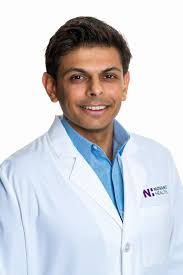
Growing up in Wilmington, Dr. Nikhil Patel loved to watch his father work. Starting in middle school, he sometimes tagged along to observe a procedure or discuss the details of a clinical case. So when his father, Dr. Praful Patel, retired, it seemed only fitting for his son to carry the touch for heart health.
“Seeing my dad as a cardiologist growing up certainly had an impact,” said Patel, whose father helped establish the Novant Health Heart & Vascular Institute in Wilmington. “And it was during medical school that I realized there’s so much you can do within the field of cardiology.”
Take the first step in improving your cardiac health.
Family matters
As a child, Patel lost two grandparents on the same day. Just hours after his maternal grandmother passed, Patel’s grandfather died from broken-heart syndrome. Also known as Takotsubo cardiomyopathy, the condition is related to stress and causes symptoms that mimic those of a heart attack. The experience was a turning point for Patel early on.
“It showed me how frail human life can be,” he said. “I learned the importance of taking care of patients during very vulnerable moments.”
It also inspired Patel to understand the value of building relationships with patients of all ages.
“I treat my patients like family,” he said. “I think it’s really important to be there talking with them when they’re in a tough spot, especially when those conversations involve end-of-life care.”
Speaking of family, Patel said he’s constantly in touch with his father, who practiced for more than 35 years.
“With cardiology you can be book-smart, but experience is key,” Patel said. “People who have been doing it for a long time have good instincts, and that’s where I think it’s really helpful talking with my dad.”
Healthcare beyond our borders
Patel completed his general medicine and cardiovascular training at Wake Forest Baptist Medical Center and joined Novant Health in October 2025.
Prior to medical school, Patel majored in economics and business administration at the University of North Carolina at Chapel Hill with the goal of also understanding the business of medicine.
As an undergraduate in 2013, he received a grant to travel to Pune, India, a city of more than 7 million people in its metro area. There he spent a month working one-on-one with cardiologists to address ways to improve preventive care in rural areas.
Using an iPhone app to act as an electrocardiogram (ECG) monitor, he screened patients for abnormal heart rhythms and developed a follow-up plan to establish care. The experience exposed Patel to the startling healthcare differences outside of the U.S.
“Unfortunately, in somewhere like India, healthcare is challenging, particularly in rural areas,” he said. “We’re so much more advanced when it comes to offering patients the ability to live longer.”
Simple heart care advice to remember
What simple things can you do to reduce your risk of a stroke or a heart attack?
For a question that seems so obvious, Patel wonders why few patients ask it.
“There’s such an overlap between mood, stress, anxiety, depression and cardiovascular disease,” Patel said. “Being mentally whole and physically active are just as important as the treatment itself.”
Depending on the extent of those factors, Patel works with patients to optimize their health, including guidance for:
- Exercising regularly
- Maintaining a healthy weight through a balanced diet
- Managing stress
- Reducing smoking (which is a major risk factor for heart disease)
Patel emphasizes that these visits are never pushy and are tailored to address each patient’s specific needs.
“The last thing I want to do is preach to patients, and instead meet them where they are,” he said. “It’s hard to break a lifestyle habit. That’s why our first interaction will not be a lecture. I want to understand where you’re coming from, and together we’ll go from there.”
Catching heart issues early
Preventive cardiology depends on early detection of a serious cardiac event.
Patel specializes in noninvasive cardiac imaging, which uses state-of-the-art technology to help diagnose patients early and guide lifesaving treatments without opening the chest.
Cardiac imaging is essential for diagnosing heart issues, and includes coronary CT, cardiac MRI, echocardiography and nuclear cardiology.
Patients who experience shortness of breath or chest pain may be referred to a general cardiologist to evaluate a heart problem such as:
- Heart disease, the leading cause of death in the U.S.
- High blood pressure, which affects nearly half of U.S. adults
- Irregular heartbeat, also known as AFib
- Heart failure, when the heart fails to deliver adequate blood
- Heart attack
Your insurance company may require a referral from your primary care provider to see a cardiologist. In some cases, the cardiologist may refer you to a specialist for heart catheterization or surgery.


